

What Our Students Say
Did you know!
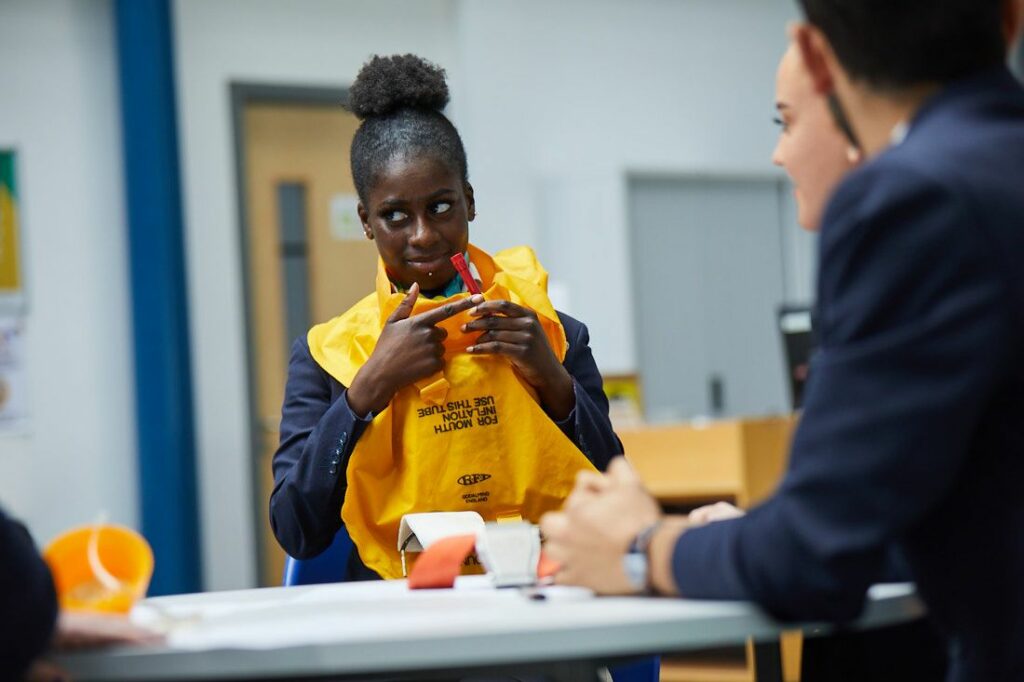
- Put your theory into practice in our state-of-the-art air cabin simulator. We also have strong links with major UK airports including Leeds Bradford to give you industry insight.
- By 2024, the leisure and travel sector in Leeds is predicted to grow by 3.1%. (EMSI, 2019)
Course Information
Introduction
Have you ever dreamed of travelling the world while working for an airline? The NCFE Level 2 Certificate in Air Cabin Crew is an exciting course designed to give you the knowledge, skills and confidence needed to begin a career in the aviation industry. You will learn about the role of cabin crew, passenger safety, customer service and emergency procedures whilst gaining practical experience in a realistic cabin environment.
Overview
This course combines classroom learning with practical activities to help you understand the day-to-day responsibilities of cabin crew. You will develop professional communication skills, learn how to deliver excellent customer service, and gain an understanding of airline safety and security procedures. Training is delivered by experienced industry professionals and includes practical sessions in a purpose-built aircraft cabin.
Who is this course for?
This course is ideal for learners aged 16–18 who are interested in a career in aviation and wish to work as Cabin Crew. It is also suitable for those looking to develop customer service, communication and teamwork skills that are valued across many industries.
Course units/modules
- Industry Standards
- Task Prioritisation
- Crew Resource Management (CRM)
- Roles and Responsibilities of Cabin Crew
- Chain of Command
- Pre-Flight and Post-Flight Duties
- Making Passenger Announcements
- Safety Demonstrations
- Airline Health and Wellbeing
- Safety and Security Procedures
- Aviation First Aid
- Aircraft Emergency Procedures
- Survival Techniques
- Conducting On-Board Sales and Customer Service
Benefits and skills
By completing this course, you will:
- Gain hands-on experience in a purpose-built aircraft cabin.
- Learn from industry experts with aviation experience.
- Develop excellent communication and customer service skills.
- Build confidence when working with members of the public.
- Understand airline safety, security and emergency procedures.
- Improve teamwork, leadership and problem-solving skills.
- Prepare for further study within the aviation, travel and tourism industries.
Entry requirements
- A minimum of 1 GCSE at Grade 4 or above.
- GCSE English Language at Grade 3 or above.
- A good standard of spoken and written English.
- An interest in aviation, travel and customer service.
Important Information About Cabin Crew Careers
This course is designed to prepare learners for employment within the airline industry. Airlines have their own recruitment requirements, which may vary between employers.
- Applicants should ideally be at least 5ft 2in (157cm) tall without shoes. Many airlines require cabin crew to be able to reach safety equipment stored in overhead compartments and may carry out reach tests as part of the recruitment process.
- It is strongly recommended that learners are able to swim at least 25 metres unaided. Swimming is a mandatory requirement for most Cabin Crew roles, as cabin crew must be able to assist passengers in emergency situations.
- If you are currently unable to swim, this may affect your future employment opportunities within the airline industry. We recommend taking swimming lessons before or during the course to improve your chances of securing a Cabin Crew role.
- Individual airlines may also require applicants to pass medical assessments, background checks, right-to-work checks and other recruitment processes before employment.
Available apprenticeships and progression options
Successful learners may progress onto:
- NCFE Level 3 Travel and Tourism qualifications.
- Level 3 Aviation qualifications.
These courses provide opportunities to further develop industry knowledge, practical skills and employability, helping learners prepare for a future career within the aviation, travel and tourism sectors.
Assessment types
Assessment is carried out through a variety of methods designed to reflect real industry practice, including:
- Practical demonstrations and activities.
- Role-play scenarios.
- Written assignments and workbooks.
- Presentations.
- Observation of practical skills.
- Knowledge-based assessments.
There are no formal examinations. Assessments are designed to help learners demonstrate the skills, knowledge and behaviours required within the aviation industry.
Employment Statistics
-
Air travel assistants
Average Salary£27,040
Follow us on Social Media