




Health and Social Care

NCFE CacheTechnical Extended Diploma , Level 3
Apply now Enquire now

Available at the following campuses:

What Our Students Say

The tutors are really helpful, most of them have actually worked as an actual like social worker or care worker, so that’s good because they can give you on-hand experience and they can tell you things they have actually experienced whilst they’ve worked, and it can help you kind of learn about health and social care because you’re learning from people who have experienced it.

Eve

Did you know!

  • Our courses range from residential care to palliative care and include work experience and placement opportunities including european residential trips.
  • In 2019 there were over 6,800 Health and Social care jobs in Leeds (Emsi).

Course Information

Introduction

Course fees are required for this level 3 course.If you are a 19+ learner you may have to pay fees. This course is eligible for Advanced Learner Loan funding and Free courses for jobs. Please ask for more details.

This course will provide you with the knowledge and understanding required for level 3 in the health and social care sector. It will equip you with the knowledge and skills to allow you to progress onto either an apprenticeship, higher education route or into full-time employment. The course for the full two years is equivalent to three A levels. There are 20 units in total which will need to be completed. These are a mixture of course work, two controlled assessment (one to be completed in year 1 and the second one in year 2) and an anatomy and physiology exam in year 2, This course is graded from A* to D grade. *UCAS Points- This course does carry UCAS points but the full two years must be completed and achieved prior to being awarded these points. Grade D= 72 UCAS points, C grade = 96, B grade = 120, A Grade 144 and A*= 168 UCAS points. You will be expected to complete 8 weeks of work placement across both years as part of a mandatory course requirement. These are broken down into two week blocks where two blocks of two weeks are completed per year (4 weeks per year). This has to be reflected on and added to the work experience platform of Navigate to meet the awarding bodies requirement. An enhanced DBS will also be required prior to going out on work placement.

Overview

Below you’ll find a glimpse of what we offer in the department and our facilities that are available.

Video Transcript

Print Download Fullscreen

Discover Health & Social Care at Leeds City College | Social Science
WCAG 2.1 Doc
Location: Quarry Hill Campus

SPEAKERS
Female Speaker 1 — Student
Female Speaker 2 — Student
Female Speaker 3 — Student
Female Speaker 4 — Staff

VIDEO BREAKDOWN
Visual: A group of public services and health students look out from the back of an open ambulance parked outside the Quarry Hill Campus. The video cuts to a classroom where a tutor in a green paramedic uniform presents to attentive students.
Female Speaker 1 — Student: “I want to be able to help people who may feel like they can’t be helped or feel like they don’t deserve the help. I’ve learned that you don’t always see what somebody has going on in their life.”
Visual: A student sits in a sensory room holding a large, reflective silver sphere, while nearby students engage in practical classroom exercises and anatomical study.
Female Speaker 1 — Student: “They just simple things really, but then obviously health and social care can be about helping people through big things and like things that are quite detrimental.”
Visual: Students fit protective equipment and work with interactive touchscreen kiosks in a clinical suite.
Female Speaker 2 — Student: “It covers a whole array of human development from pre-cradle right through to old age. In a way, it’s catered for everyone, I think.”
Visual: A student wears a yellow geriatric simulation suit and uses a walking cane under tutor supervision.
Female Speaker 2 — Student: “There’s so many components that you’re going to find one that you like. And I think that’s what I have found the most with this course is that it’s for everyone.”
Visual: Students examine case study notes and work with culinary ingredients in a modern training kitchen.
Female Speaker 3 — Student: “We are so, so lucky. So we’ve got the hands-on facilities, we’ve got clinical, practical clinical suite. We’ve got an anatomy table, we’ve got hoists,”
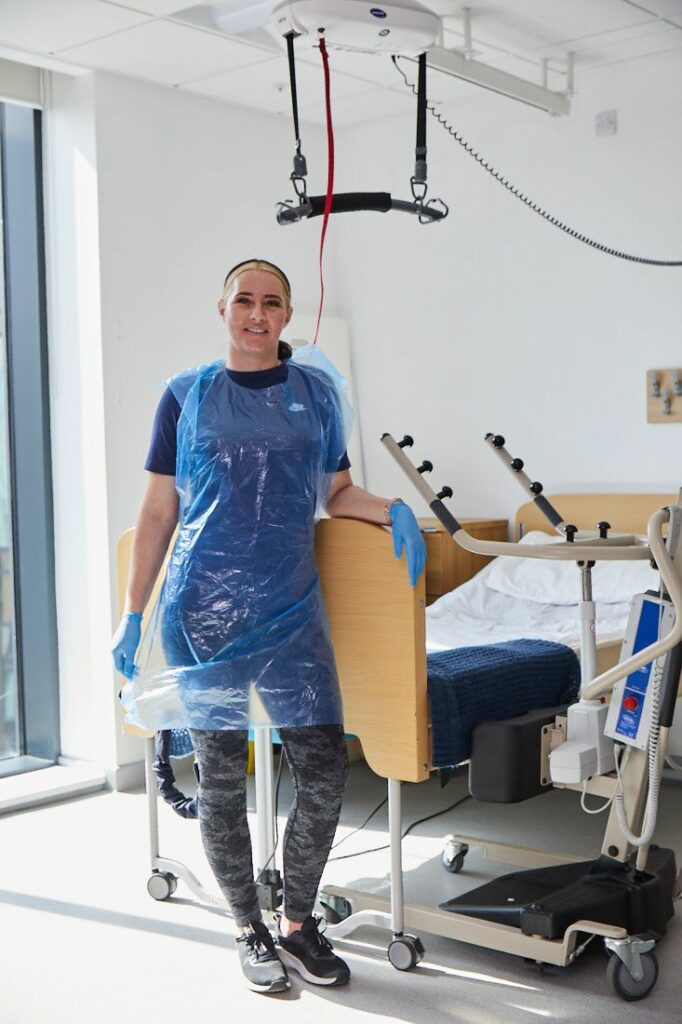
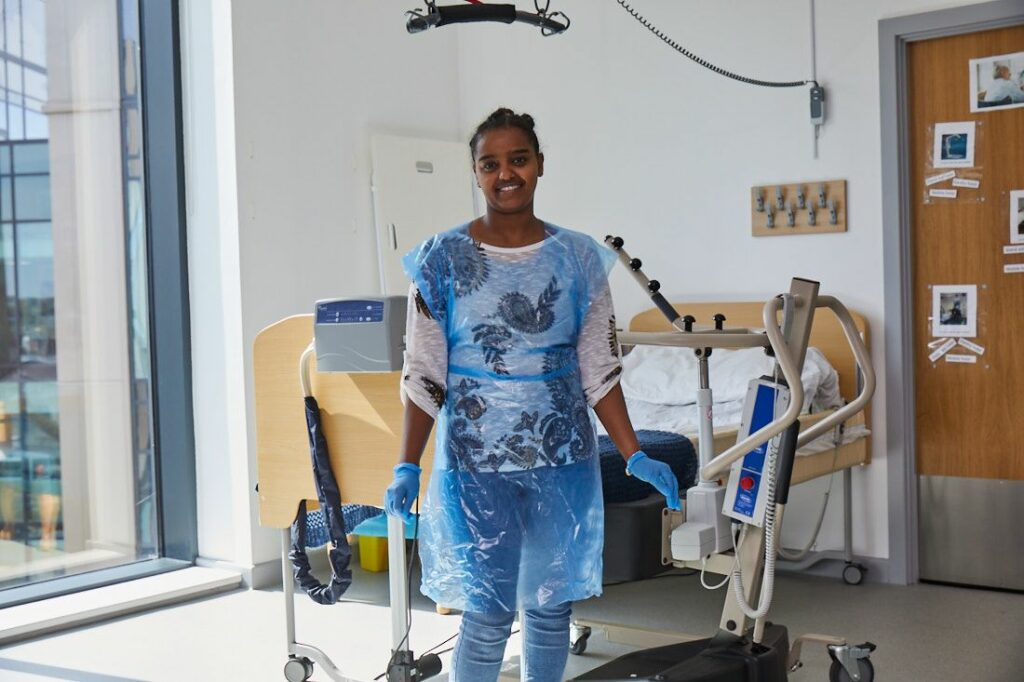
Visual: Students practice operating an overhead ceiling hoist over a hospital bed in a mock ward setting, then interact with a life-like baby mannequin.
Female Speaker 3 — Student: “we’ve got VR headsets, interactive babies. They have stuff where you can get hands-on experience even if you’re not on placement. So we can be creative…”
Visual: Students look through microscopes in a science laboratory while others engage in creative art therapy tasks.
Female Speaker 4 — Staff: “…as we wish, within our teaching and learning, we are following what employers need locally. So a college course like this is perfect in preparing people, giving them the basics of being able to provide care, compassion, talk to people…”
Visual: An ambulance is parked on campus as a paramedic tutor demonstrates emergency equipment to students outside and inside the vehicle.
Female Speaker 4 — Staff: “…by being able to use transferable skills from different placements and dealing with different people in different age groups, allows you to build on the foundations you learn in college course to be able to then take it out into practice.”
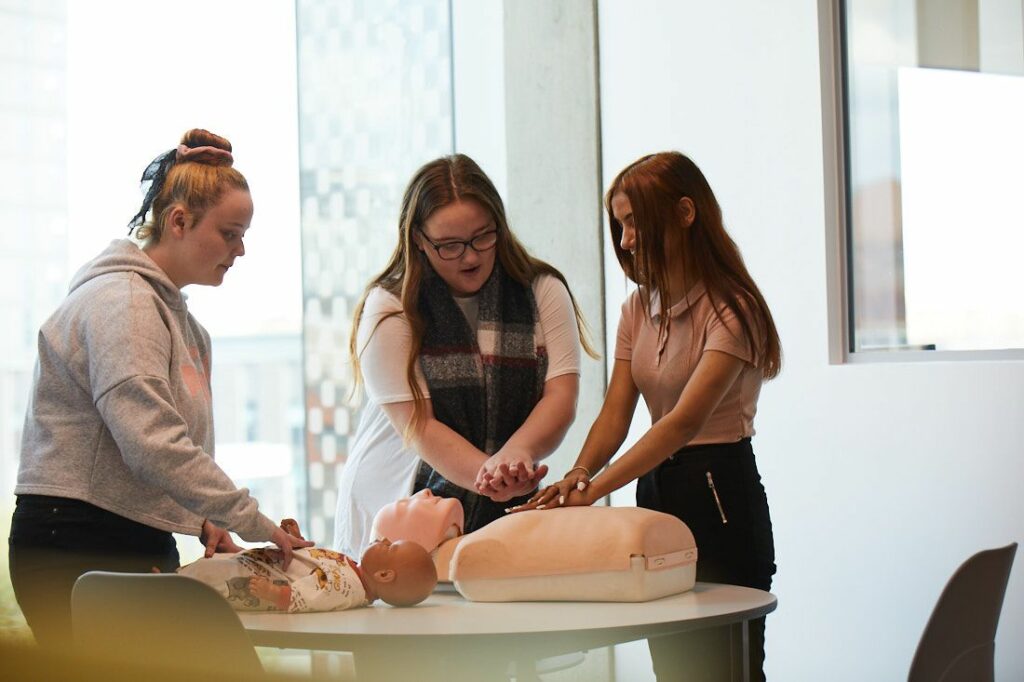
Visual: Tutors demonstrate medical equipment, CPR techniques on an interactive training station, and mobility hoists in a simulated care suite.
Female Speaker 1 — Student: “One of my favorite parts of my course was that I just enjoyed spending time with the teachers and them teaching me.”
Visual: A lecturer teaches at an interactive whiteboard in a classroom while other instructors guide practical work in clinical rooms.
Female Speaker 2 — Student: “The tutors here are like really sweet. Even the ones who aren’t my tutors will still like come up and ask how I’m doing and stuff. So helpful, like you could, no question is too silly. They’ll always be there to help you.”
Visual: Students interact with tutors in soft sensory environments and clinical skill suites.
Female Speaker 2 — Student: “Um and it helps with the learning because when you have that relationship with them, it’s kind of like just an understanding and mutual understanding that what you’re here to do, they just they understand, they get you. So college has really, really helped with like me working out how I’m actually going to get into…”
Visual: Students engage in laboratory work, sensory light therapy, and virtual reality simulations.
Female Speaker 2 — Student: “…on a lunch break. The college has helped with me finding my options. I would say definitely come to like an open event or any sort of open days that they have because they are very good and they are very like true to what a day, a normal day would look like at college.”
Visual: Low-angle exterior shot of the glass facades of Quarry Hill Campus under a clear blue sky, followed by students walking through hallways and collaborating in study lounge areas.
Female Speaker 4 — Staff: “We’re really fortunate. Sounds a bit cliché, but we get young people who are leaving school and then we see them as young adults ready to go in the world. Just to watch that growth and the confidence and their life skills develop.”
Visual: Students wear Meta Quest VR headsets with controllers in an immersive classroom, operate ceiling hoists, and examine slides through laboratory microscopes.
Female Speaker 4 — Staff: “So we use what’s called restorative practice and that is the heart of what our ethos is. We are all about giving second chances. It’s about nurturing talent, it’s about nurturing individuals and it’s about working with those individuals to get the best outcome possible.”
Visual: A close-up shot of a glowing blue sensory light orb being held in a sensory room transitions to a green screen displaying official department branding.
On-screen text & Graphics: SCHOOL OF SOCIAL SCIENCE LEEDS CITY COLLEGE

Who is this course for?

If you’re in year 11 or 12 and are looking to take the next steps towards your career these courses are for you. Our vast selection of vocational courses span a range of subjects and combine academic study with practical skills. Study in industry standard facilities and use our industry links to prepare for progression.

Course units/modules

Course units

  • Working in Health and social care
  • Reflective Practice
  • Research skills in health and social care
  • Personal and professional development
  • Anatomy and Physiology
  • Mental health and wellbeing
  • Equality, Diversity and Rights
  • Sociological perspectives in health and social care
  • Psychological perspectives in health and social care
  • Safeguarding
  • Human Growth and Development
  • Communication in Health and Social care
  • Infection, prevention and control
  • Empowerment
  • Protection of children, young people & adults
  • Physiology of co-ordination
  • Nutrition in health and social care
  • Family issue

Benefits and skills

  • Safeguard and protect vulnerable adults, children and patients.
  • Gain an understanding of infection prevention and control.
  • Understand the responsibilities of working in professional care.
  • Develop the skills to care for others.
  • Entry requirements

    Five GCSEs at grade 4 including English and maths. A minimum of grade 3 in science though grade 4 is desirable.

    Available apprenticeships and progression options

    Progression can either be onto employment within the sector, an apprenticeship which will further enhance skills and knowledge or progress onto University to study a Higher Education in all social care degrees. Please check with each university the entry requirements to their courses.

    Course details

    Duration: 2 years
    Start Date: 06/09/2027
    Fees (16-18): No fee
    Study Type: Full time
    Course Code: 79210-01

    Employment Statistics

    • Health Associate Professionals n.e.c.

      Average Salary
      £15.58
    • Nursing Auxiliaries and Assistants

      Average Salary
      £14.28
    • Senior Care Workers

      Average Salary
      £26,771

    You may also be interested in

    Contact us